Monday, August 18, 2014

Lightning!

Tonight, I had a bit of a close call with a lightning strike.  I had just driven up to my barn and was about to leave the car to take a horse out to his field when I decided to check the good ol' RadarScope app on my phone (amazing app that I highly recommend!).  I noticed that there was a storm about 10 miles to the north of my location and a squall line about 45 minutes away from where I was.  I'd seen a few flashes of lightning on my drive out to the barn but they'd seemed relatively far away. 

I had my hand on the door handle when just south of the farm, lightning struck!  It was incredibly loud but still assumed it was at least a mile away.  It wasn't until I got home (we live just south of where the farm is located...probably less then a mile) that my husband asked about the lightning strike he saw hit from just north of the house.  That strike occurred in between the farm and the house and the closest storm was at least 10 miles away!

With all the weather data at our fingertips, it's so easy to be lulled into a false sense of security if you don't see a storm directly over your location.  I incorrectly assumed I'd have at least 45 minutes to get all my outdoor chores done before there would be any sort of lightning danger.  It was dumb as I'd seen several lightning flashes and know that if you can hear thunder then lightning can strike.  I in no way think that having such amazing access to weather data is a negative.  It's just still important to remember basic weather rules.  My meteorology degree couldn't have saved me tonight when I almost went out to play in a thunderstorm!  Please remember, "When thunder roars, go indoors!" (NWS Lightning Safety).

Lightning strikes from VAISALA this evening.  The map was generated around 830pm EDT.

Tuesday, July 15, 2014

A Little about International Equestrian Sports

Many nations on 6 continents participate in international equestrian competitions.  The Federation Equestre Internationale (FEI) founded in 1921 is the governing body that oversees these competitions including the World Equestrian Games.  FEI  disciplines include: Jumping, Dressage and Para Dressage, Eventing, Driving and Para Driving, Endurance, Vaulting and Reining.


The goal of the FEI is to maintain competitions that uphold the FEI standards of Equality, Fair Play, Complicity with the Animal, Respect for the Environment and Respect for the Horse.  Regulations and the approval process for competitions are determined by 7 stakeholder groups that include the FEI President (HRH Princess Haya) and National Federations (there are 132).  Many National Federation have additional equestrian sports that are not recognized internationally.  For example, the United States Equestrian Federation gives out annual awards for events that include Saddleseat Equitation and Western Pleasure.  It's the responsibility of these national federations to choose teams to represent their nation for the World Equestrian Games, Olympics and other international competitions.  

The French national equestrian federation, called Federation Francaise d'Equitation, governs many competitions not recognized by the FEI.  Two that I find really interesting are a sport called TREC and Skijoring with horses.

http://www.ffe.com/Disciplines-Equestres/General/TREC/Presentation-du-TREC
TREC competitions involve four separate components.  The TREC acronym stands for 'Techniques de Randonnee Equestre de Competition', which roughly translates to Techniques Hiking Equestrian Competition.  The first test is where a rider must plan a course along a marked route using a topographic map of a course between 12-50km.  Twenty minutes before the competition starts, management reviews the planned course and during the riding of the course, there are unknown checkpoints.  Efficiency in route planning and long distance ride management is tested here.  The second part of the competition involves obstacles that may be encountered on a trail.  They can include anything from fording a creek, stairs, a series of rapid jumps, opening a gate and obstacles where the rider must dismount from their horse and complete the obstacle themselves.  During the third phase, riders meet with the officials and describe what tack they're using.  They take off their saddle bags and discuss any first aid supplies they carry and why they use the equipment that they do.  Lastly, a dressage test completes the competition.  The dressage test focuses on the ability of the rider to control their mount.  As someone who enjoys hiking, this seems like quite the fun competition!

http://www.ffe.com/Disciplines-Equestres/Culture-Tradition/Ski-joeering/Presentation-du-Ski-Joering
Having lived in Alaska for a little bit, I usually think of skijoring as a sport where a dog pulls a skier along behind him.  Skijoring with horses is very similar except the four legged mammal doing the pulling weighs 1000 pounds more!  Races can be held on snow, grass or sand and are held on a circular race track.  Below is a video that explains a little bit about this sport.  Most of the time the horses are riderless but I did see a few videos where there were riders.  If you're an adrenaline junkie, this may be the sport for you! 

\

There are a lot more very neat competitions in the 132 national federations recognized by the FEI.  We'll definitely take a look at some more in future posts!


Wednesday, July 9, 2014

Weather Forecasting in France Part II: Radar Coverage

Once used solely for military purposes, radar technology is now an indispensable tool meteorologists use in forecasting.  Radars send out a beam of energy, which is returned to the radar when it comes into contact with a rain drop, hail stone, snow flake or any other falling precipitation.  The amount of energy returned to the radar and the time it takes for the energy to return indicate the type and intensity of the precipitation.  Recently, many radars around the globe are being upgraded to something called dual-polarization.  This means that 2 beams of energy are sent out simultaneously.  One is oriented in the horizontal and one in the vertical.  France currently has 17 radars upgraded to dual-polarization.

Meteo France has 27 radars total.  Twenty-four of the radars return information from a 100km radius and three of the radars from a radius of 60km.  Most of France (seen in the image below) has radar coverage with many areas having overlapping coverage.  This overlapping coverage is helpful in seeing storms and areas of precipitation from multiple angles. (numbers from http://www.meteofrance.com/accueil)


The shaded blue/red/green areas show the extent of where data can be seen from the points in the middle of each circle (radar's location).  The smaller green shaded areas are radars that are in test phase and the ones with a smaller radius of 60km.  'Dpol' shows which radars have been updated to dual-polarization!

The Meteo France website shows a looping composite image (combination of all radars).  At the time this post was written, an area of rain was moving to the south from the northeastern coast across central France.  These radars are going to play in integral role during the 2 weeks of the World Equestrian Games!

http://www.meteofrance.com/previsions-meteo-france/animation/radar/france


Monday, June 2, 2014

Weather Forecasting in France Part I: Adverse Weather Information

Most countries across the globe have their own nationally funded public meteorological organizations.  For France, weather forecasts, warnings and climate information is put out by Meteo France.  There's also an initiative strongly supported by the World Meteorological Organization (or WMO, which is a part of the United Nations) that most of the European nations are participating in to compile severe weather information in one location.  This is called Meteoalarm and is offered in 32 languages.

Each country's website for their National Weather Service (including France) is available in a limited number of languages.  This is one of the many reasons why I'm immensely grateful for these guys:


my wonderful husband and son.  One of them is a fellow meteorologist and fluent in French, can you guess which one?  Hint: I'm pretty sure our son said the word 'radar' to us the other day.  

In all seriousness, my  husband as been a big help in translating information from the Meteo France website.  I know there are many wonderful websites that provide world wide weather information but I personally prefer to look at information produced by national centers.  Forecasters at national weather services tend to have a better understanding of the microclimates of the regions for which they forecast.  They actually are living in the country where they forecast!  Information gleaned from a world wide weather website is generally from a forecast compiled directly from a computer model(s).  These forecasts are not quality controlled by a human forecaster.  Even with the tremendous computing power used to run weather models, I really believe that the human input into a forecast is essential.  There were multiple instances this past winter along the east coast of the United States where non-meteorologists were posting alarming images taken straight from a single model simulation.  My husband and I received many emails, phone calls and texts about these images.  None of the 'super storms' the single model simulations indicated came to fruition and it was a bit disturbing that people without meteorological training caused such alarm.  All computer models of the atmosphere have biases and many times in single runs (models are run 4 times to as many as 24 times a day) produce really outlandish results for later in the forecast cycle (days 5 and on).  It's important to get weather information from a trusted source like a national weather service, local/national news outlets and respected weather websites!  For the United States, look for the following seals that indicate a rigorous approval process to achieve:

ams certifiedccmseal of approval
NWA Seal of Approval
 
There is no seal or certification process available at this moment for blogs and amateur weather enthusiasts.  The logos above will be found for broadcast meteorologists and weather consultants. 

Alright, I'm going to take a step down from my little soap box and get back to how information about adverse weather is disseminated in Europe.  As I mentioned above, Meteoalarm compiles adverse weather information for most European nations in a single easy to access website.  Meteoalarm is a part of EUMETNET, which was established to provide a framework to share information across European national centers.

Flags from the 34 countries that participate in the Meteoalarm initiative along with a shaded map of Europe (where green, yellow, orange and red indicate a scale of increasing weather danger) are available on the Meteoalarm home page.  By clicking on the country's flag or the map, you can get more information about the adverse weather expected.  For today in the Alps de Haute Provence and the Alps Maritimes regions individuals should be on the lookout for thunderstorms, some of which could cause strong winds.  

http://www.meteoalarm.eu/en_UK/0/0/FR-France.html 
Click on the image to go to the Meteoalarm France page.

Information is also available for the next day's expected adverse weather by clicking on the 'tomorrow' tab underneath maps displayed on any page.  Further information about weather conditions can be found by clicking on the Meteo France logo (this is where knowledge of French comes in handy!).  


http://vigilance.meteofrance.com/

 Click on this image to go to the Meteo France page.

This should get you started in your perusing of weather information for Europe!  More posts this week will talk about what different weather warnings mean in France, the French radar network, European weather observations, the weather models that Meteo France uses and what the weather will be like this weekend in Normandy.  As always, be weather aware!


Thursday, May 8, 2014

World Equestrian Games Outlook Part I - Climate of Normandy, France

World Equestrian Games logo from http://www.normandy2014.com/.

Every four years, the top horses and horsemen from around the world gather together to compete in the World Equestrian Games (WEG).  It's held on even numbered years 2 years after the last summer Olympic games.  This summer's games will be held in Normandy, France a 2 and a half hour drive west of Paris and just south of the English Channel.  The events will range from the region's capital of Caen, to the beaches of Normandy and south into the Orne region.


What helps to make the WEG a very special event  to the horse world is that it spans 9 disciplines (jumping, dressage, eventing, driving, endurance, vaulting, reining and para-dressage)!  2014's games also feature two disciplines in what's called 'In Exhibition'.  These are polo and horse-ball (yup...basketball with horses!), which will hopefully raise awareness of these sports to the general public.  Events will take place over a two week period starting August 23rd and ending September 7th.  From the list of events above, it's clear that not all the competitions will be able to be held in an arena in a climate controlled setting.  Eventing, driving and endurance in particular are activities that necessitate (miles/kilometers) large areas of land.  Weather will be a key factor for the WEG.

Today's post will take a look at what the diurnal temperature range (daytime high temp and nightly low temp) is typically like at the end of the summer/beginning of fall in Normandy and what weather conditions may be present.  It's impossible to forecast what the weather will be like during the WEG but we can take a look at average temperatures and what may happen.  Tomorrow's post will investigate how weather information is sent out in France and how warnings are issued.  Each country has it's own organization that sends out weather information and their own ways of disseminating that information!

Normandy is located at about 49 degrees N in latitude, which is approximately the same location north as the Montana/Canadian border.  The ocean plays a large part in northwestern France's climate.  The mild current flowing eastward from Nova Scotia is called the North Atlantic Drift and brings a moderating influence to western Europe.  For Normandy, this results in cool winters that are certainly not as cold as winters in the majority of Montana and summers that are cooler than a more landlocked location.

 For a neat visualization of ocean currents in the North Atlantic, visit: http://svs.gsfc.nasa.gov/vis/a000000/a003800/a003827/.  This was put together by NASA Goddard Space Flight Center.

The climate of not just Normandy but the majority of France is classified as Cfb under a system called the Koppen-Geiger Climate Classification.  Cfb (where C is the main climate classification, f is precipitation and b is temperature) stands for: C-warm temperate, f-fully humid and b-warm summer.  The following map of the world shows France in the same zone as the Pacific northwest of the United States into British Columbia.  As you all know, those areas have quite mild and pleasant weather conditions a lot of the time.  It's not a bad climate in which to have a large horse competition!

From http://koeppen-geiger.vu-wien.ac.at/.
   

Since the ocean plays such a moderating influence for Normandy, temperatures do not change that drastically from day to night.  Average daytime high temperatures for the end if August and beginning of September for Caen are around 21C (~70F) and night time lows are around 11-12C (~53F).  This is 10C (or 17F) change in temperature from day to night.  At 49 degrees N latitude, there are about 13 hours of daylight at this time of year.  The longer days of summer are just starting to wind down!  The summer months in Caen tend to be some of the drier months for the region with November being the rainiest.  Afternoon showers are always a possibility in the summer along with a coastal low pressure system that could impact the region.  For the endurance competition that will take place along the coast, daily sea breeze and land breezes (cool onshore flow from the ocean during the day and flow out to the ocean at night) could impact the event.  The extent of the impact will be determined by the daily temperature and the current atmospheric conditions.

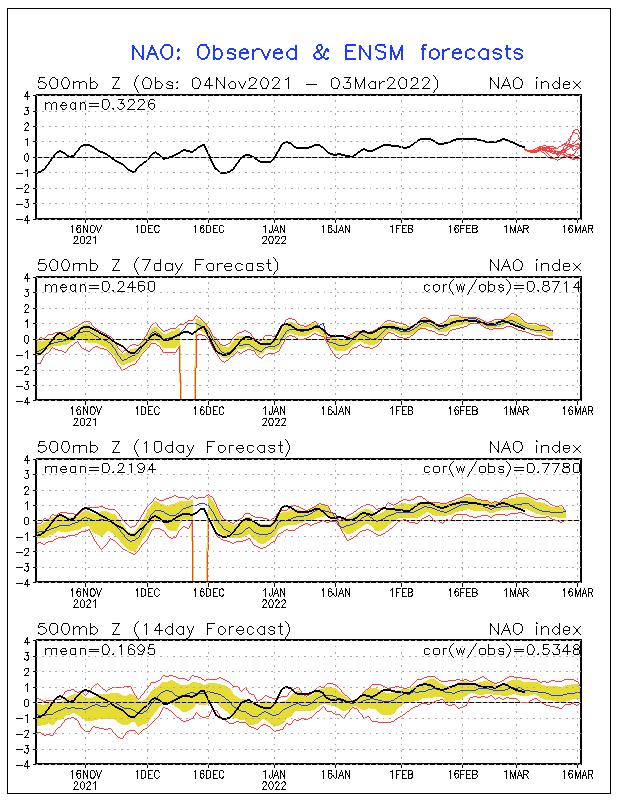
One last climate factor to mention is something called the North Atlantic Oscillation (NAO).  The NAO is measure of height and pressure anomalies from over Greenland and from farther south over the North Atlantic (35N-40N latitude).  It's depicted in what's called a 'negative' or 'positive' anomaly.  For a positive anomaly, northern France in the summer could see higher then average temperatures and the opposite for a negative anomaly.  The NAO also impacts the location of the North Atlantic jet stream, which plays a large part in steering storm systems.  Leading up to the WEG, the current NAO index and subsequent jet location will give us an idea of where large-scale weather systems could be steered!  At this moment, the NAO index is slightly negative and forecasted to climb near 0.  The Climate Prediction Center of the National Weather Service (NOAA) puts out a 14-day NAO outlook: http://www.cpc.ncep.noaa.gov/products/precip/CWlink/pna/nao.sprd2.gif.  When we get to mid-August this is definitely something we will be paying attention to!

We're excited about the World Equestrian Games and it's beautiful location in Normandy!  Check back tomorrow for a more detailed look at how weather is forecasted in France.  Please leave a comment or email equuswx@gmail.com with any questions and be sure to visit www.equuswx.com!               


Websites/References:
http://www.normandy2014.com/
http://koeppen-geiger.vu-wien.ac.at/
http://www.caen.climatemps.com/
http://www.cpc.ncep.noaa.gov/

Friday, May 2, 2014

Thunderstorms - To Turnout or Not Turnout?

Horse people know that when severe weather threatens having horses adds a whole other aspect of preparedness that needs to be considered.  Most everyone has heard what actions you personally should take when tornadoes and severe thunderstorms are expected: 

-Do you have that interior ground floor level room ready to be occupied in the event of a tornado warning?  Check. 
-Is everyone in your family accounted for and familiar with the chosen sheltering room?  Check. 
-Are your dogs/cats/birds/turtles (whatever!) easily transported to or already in your room of choice?  Check. 
-Can I get my horse into the house and if not into the interior room at least away from windows?  Probably. 
-Is this a good idea?  Probably not!

So what do you do with your horses when severe weather is expected?  This is something that I've thought a lot about through the years as it's not just my horses that my family was responsible for but our boarders horses.  Unfortunately, there's not a black and white answer to this.  Like most things when dealing with horses, a lot of preparation and a little common sense is involved!  Hopefully, the following information will help you tailor a weather preparedness plan specific to your horses' needs and give you piece of mind when the next thunderstorms roll through. 

Photo credit: Paul Suffern from the DC, Virginia and Maryland derecho event that took place the late evening of June 29, 2012.  Our horses were in the barn for this!


Preparations


One thing to definitely keep in mind while reading through the rest of this article is that if you can hear thunder then lightning can strike where you are.  Thunderstorms are not the time to be riding a horse and at the first sound of thunder or when you know a storm is approaching is the time to head back to the barn (or already be in the barn)! 

There are several things you can do prior to a severe convective (weather people like to use the word convection when talking about thunderstorms) event that make potential power losses less traumatic and make dealing with storm damage easier.  Here's the check list that I run through before severe weather:
  • Do I have enough water or a water source in case we lose power? 
Like most barns, our place is fed by well water and a pump, which does not work without electricity.  We do have a generator but like to have stored water for 48 hours just in case.  You can use pond water if you have a pond but also have several 5 gallon gas cans reserved to hold JUST water.  You can get them at Target, Southern States or pretty much anywhere.  Just make sure you write on the can that it's only to be used for water!  Also, filling up outside water troughs to the brim is a good idea.

  • Do I have enough hay and feed to make it several days?
  • Do I have enough gas for my generators if I'm planning on using them?
  • Do I have 10-20 spare fence boards and a few 4x4s in case of damage?
If storms cause damage, lots of people will be running to Home Depot so they can make repairs.  It's nice to have spare fencing so you don't have to go to the store with everyone else!
  • Are the horse trailers parked away from trees? 
We had a branch come very close to hitting one of the trailers parked at our farm one time.  Ever since then, I've tried to leave them away from under large limbs when parking.

Turnout


Turnout during severe weather is a situation where you need to consider your horses' specific living conditions.  It may be better for someone a mile down the road to leave their horses out while it's best for your horse to stay in side.  If you have a large field with a very small number of trees it could be best to leave the horses outside.  That way they are not trapped inside the barn if the structure to the barn is compromised.  It's even better if there is a run-in in the field where the horses can be sheltered from hail and flying debris on three sides.

Our farm is located in central North Carolina and most of our fields have a lot of trees that the horses like to stand under when it's raining.  For our specific situation, I feel like they are safer inside the barn away from flying debris then outside.  We've had numerous trees fall down inside the fields during storms so when we know thunderstorms are likely (and especially with severe storms) we keep them in their stalls. 

A major consideration when deciding to keep your horse up or turn them out is your horse's temperament.  Is your horse used to being stalled or outside all the time?  A horse used to 24 hour turnout will be pretty unhappy being put inside for 12 hours.  I say 12 hours because turnout decisions most of the time have to be made at morning and evening feedings.  Most jobs don't let you run home to put your horse inside whenever a thunderstorm is approaching!  Horses used to being out all the time could hurt themselves running around on slick ground with pent-up energy when put back outside.  A horse that's used to being in a stall and in regular work will be find inside.  Communicating your weather plan to other caregivers to your horse is also important.  You don't want your house sitter having to deal with a mess when you're out of town!

Weather Information


So where do you find information about severe weather that will help in your daily horse care routine?  The United States National Weather Service has 122 offices with about 20 forecasters per office across the United States http://www.weather.gov/.
 Photo Credit: http://www.srh.noaa.gov/

Each office has forecasters that work around the clock every day of the year.  They are the ones who put out the Watches and Warnings you hear on your weather radio, TV, smart phones and radio!  When you visit http://www.weather.gov/ go to the top left corner and type your zip code and you'll be taken to a page with a forecast for your specific area.  All active warnings, watches and advisories are posted underneath a red bar above the forecast graphics.  The image to the left below shows a circled flood warning and the one to the right a product called the 'Hazardous Weather Outlook' (or HWO).  The HWO is a good thing to look at as it will mention the possibility of severe thunderstorms several days in advance.


Your local news stations are a great resource for severe weather!  Make sure to watch your local news as the National Weather Service and media communicate frequently.  A lot of local news stations have weather apps for your phone so be sure to check on that as well.  

One last weather resource is something called the 'Convective Outlook' issued by the Storm Prediction Center based out of Norman, OK: http://www.spc.noaa.gov/products/outlook/.  They will highlight out to 3 days the potential for severe thunderstorms to develop.  There are 4 levels that you will see, each signified by a different color.  Green is called 'SEE TEXT' and means the area is being watched because conditions could develop that may lead to severe thunderstorms.  Yellow is a 'SLIGHT' risk and means there's an elevated chance that severe weather may occur.  Red is a 'MODERATE' risk and means the situation is pretty serious.  Severe storms are expected to develop and people need to pay very close attention to the weather.  Purple is 'HIGH' risk, which you see maybe once or twice a year.  When you see a high risk for your area, it's an extremely dangerous situation.  Definitely activate your severe weather plan!  

I hope this information has been helpful or at least will ease your mind the next time storms affect your area!  Please send an email to equuswx@gmail.com if you have any questions and visit http://www.equuswx.com/!