 |
| World Equestrian Games logo from http://www.normandy2014.com/. |
Every four years, the top horses and horsemen from around the world gather together to compete in the World Equestrian Games (WEG). It's held on even numbered years 2 years after the last summer Olympic games. This summer's games will be held in Normandy, France a 2 and a half hour drive west of Paris and just south of the English Channel. The events will range from the region's capital of Caen, to the beaches of Normandy and south into the Orne region.

What helps to make the WEG a very special event to the horse world is that it spans 9 disciplines (jumping, dressage, eventing, driving, endurance, vaulting, reining and para-dressage)! 2014's games also feature two disciplines in what's called 'In Exhibition'. These are polo and horse-ball (yup...basketball with horses!), which will hopefully raise awareness of these sports to the general public. Events will take place over a two week period starting August 23rd and ending September 7th. From the list of events above, it's clear that not all the competitions will be able to be held in an arena in a climate controlled setting. Eventing, driving and endurance in particular are activities that necessitate (miles/kilometers) large areas of land. Weather will be a key factor for the WEG.
Today's post will take a look at what the diurnal temperature range (daytime high temp and nightly low temp) is typically like at the end of the summer/beginning of fall in Normandy and what weather conditions may be present. It's impossible to forecast what the weather will be like during the WEG but we can take a look at average temperatures and what may happen. Tomorrow's post will investigate how weather information is sent out in France and how warnings are issued. Each country has it's own organization that sends out weather information and their own ways of disseminating that information!
Normandy is located at about 49 degrees N in latitude, which is approximately the same location north as the Montana/Canadian border. The ocean plays a large part in northwestern France's climate. The mild current flowing eastward from Nova Scotia is called the North Atlantic Drift and brings a moderating influence to western Europe. For Normandy, this results in cool winters that are certainly not as cold as winters in the majority of Montana and summers that are cooler than a more landlocked location.
 |
| For a neat visualization of ocean currents in the North Atlantic, visit: http://svs.gsfc.nasa.gov/vis/a000000/a003800/a003827/. This was put together by NASA Goddard Space Flight Center. |
 |
| From http://koeppen-geiger.vu-wien.ac.at/. |
Since the ocean plays such a moderating influence for Normandy, temperatures do not change that drastically from day to night. Average daytime high temperatures for the end if August and beginning of September for Caen are around 21C (~70F) and night time lows are around 11-12C (~53F). This is 10C (or 17F) change in temperature from day to night. At 49 degrees N latitude, there are about 13 hours of daylight at this time of year. The longer days of summer are just starting to wind down! The summer months in Caen tend to be some of the drier months for the region with November being the rainiest. Afternoon showers are always a possibility in the summer along with a coastal low pressure system that could impact the region. For the endurance competition that will take place along the coast, daily sea breeze and land breezes (cool onshore flow from the ocean during the day and flow out to the ocean at night) could impact the event. The extent of the impact will be determined by the daily temperature and the current atmospheric conditions.
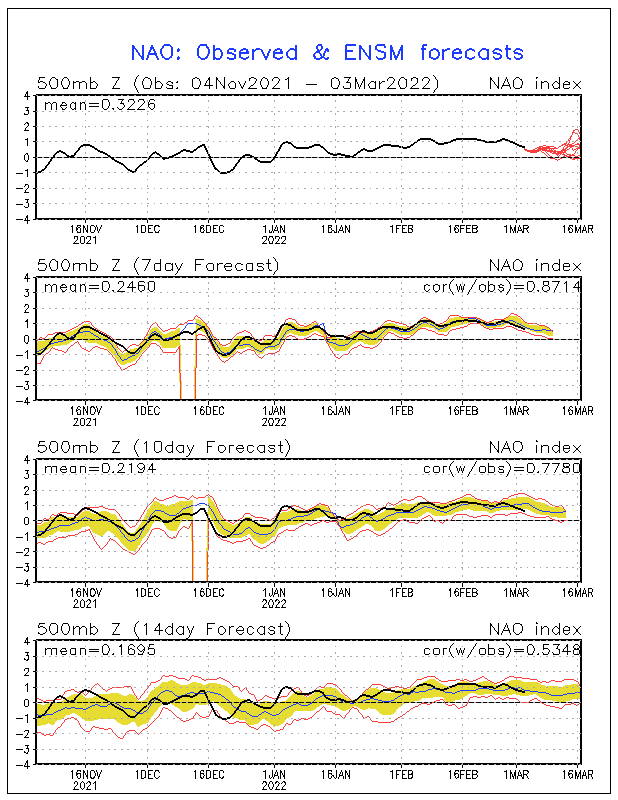
One last climate factor to mention is something called the North Atlantic Oscillation (NAO). The NAO is measure of height and pressure anomalies from over Greenland and from farther south over the North Atlantic (35N-40N latitude). It's depicted in what's called a 'negative' or 'positive' anomaly. For a positive anomaly, northern France in the summer could see higher then average temperatures and the opposite for a negative anomaly. The NAO also impacts the location of the North Atlantic jet stream, which plays a large part in steering storm systems. Leading up to the WEG, the current NAO index and subsequent jet location will give us an idea of where large-scale weather systems could be steered! At this moment, the NAO index is slightly negative and forecasted to climb near 0. The Climate Prediction Center of the National Weather Service (NOAA) puts out a 14-day NAO outlook: http://www.cpc.ncep.noaa.gov/products/precip/CWlink/pna/nao.sprd2.gif. When we get to mid-August this is definitely something we will be paying attention to!
We're excited about the World Equestrian Games and it's beautiful location in Normandy! Check back tomorrow for a more detailed look at how weather is forecasted in France. Please leave a comment or email equuswx@gmail.com with any questions and be sure to visit www.equuswx.com!
Websites/References:
http://www.normandy2014.com/
http://koeppen-geiger.vu-wien.ac.at/
http://www.caen.climatemps.com/
http://www.cpc.ncep.noaa.gov/


No comments:
Post a Comment