Thursday, May 8, 2014

World Equestrian Games Outlook Part I - Climate of Normandy, France

World Equestrian Games logo from http://www.normandy2014.com/.

Every four years, the top horses and horsemen from around the world gather together to compete in the World Equestrian Games (WEG).  It's held on even numbered years 2 years after the last summer Olympic games.  This summer's games will be held in Normandy, France a 2 and a half hour drive west of Paris and just south of the English Channel.  The events will range from the region's capital of Caen, to the beaches of Normandy and south into the Orne region.


What helps to make the WEG a very special event  to the horse world is that it spans 9 disciplines (jumping, dressage, eventing, driving, endurance, vaulting, reining and para-dressage)!  2014's games also feature two disciplines in what's called 'In Exhibition'.  These are polo and horse-ball (yup...basketball with horses!), which will hopefully raise awareness of these sports to the general public.  Events will take place over a two week period starting August 23rd and ending September 7th.  From the list of events above, it's clear that not all the competitions will be able to be held in an arena in a climate controlled setting.  Eventing, driving and endurance in particular are activities that necessitate (miles/kilometers) large areas of land.  Weather will be a key factor for the WEG.

Today's post will take a look at what the diurnal temperature range (daytime high temp and nightly low temp) is typically like at the end of the summer/beginning of fall in Normandy and what weather conditions may be present.  It's impossible to forecast what the weather will be like during the WEG but we can take a look at average temperatures and what may happen.  Tomorrow's post will investigate how weather information is sent out in France and how warnings are issued.  Each country has it's own organization that sends out weather information and their own ways of disseminating that information!

Normandy is located at about 49 degrees N in latitude, which is approximately the same location north as the Montana/Canadian border.  The ocean plays a large part in northwestern France's climate.  The mild current flowing eastward from Nova Scotia is called the North Atlantic Drift and brings a moderating influence to western Europe.  For Normandy, this results in cool winters that are certainly not as cold as winters in the majority of Montana and summers that are cooler than a more landlocked location.

 For a neat visualization of ocean currents in the North Atlantic, visit: http://svs.gsfc.nasa.gov/vis/a000000/a003800/a003827/.  This was put together by NASA Goddard Space Flight Center.

The climate of not just Normandy but the majority of France is classified as Cfb under a system called the Koppen-Geiger Climate Classification.  Cfb (where C is the main climate classification, f is precipitation and b is temperature) stands for: C-warm temperate, f-fully humid and b-warm summer.  The following map of the world shows France in the same zone as the Pacific northwest of the United States into British Columbia.  As you all know, those areas have quite mild and pleasant weather conditions a lot of the time.  It's not a bad climate in which to have a large horse competition!

From http://koeppen-geiger.vu-wien.ac.at/.
   

Since the ocean plays such a moderating influence for Normandy, temperatures do not change that drastically from day to night.  Average daytime high temperatures for the end if August and beginning of September for Caen are around 21C (~70F) and night time lows are around 11-12C (~53F).  This is 10C (or 17F) change in temperature from day to night.  At 49 degrees N latitude, there are about 13 hours of daylight at this time of year.  The longer days of summer are just starting to wind down!  The summer months in Caen tend to be some of the drier months for the region with November being the rainiest.  Afternoon showers are always a possibility in the summer along with a coastal low pressure system that could impact the region.  For the endurance competition that will take place along the coast, daily sea breeze and land breezes (cool onshore flow from the ocean during the day and flow out to the ocean at night) could impact the event.  The extent of the impact will be determined by the daily temperature and the current atmospheric conditions.

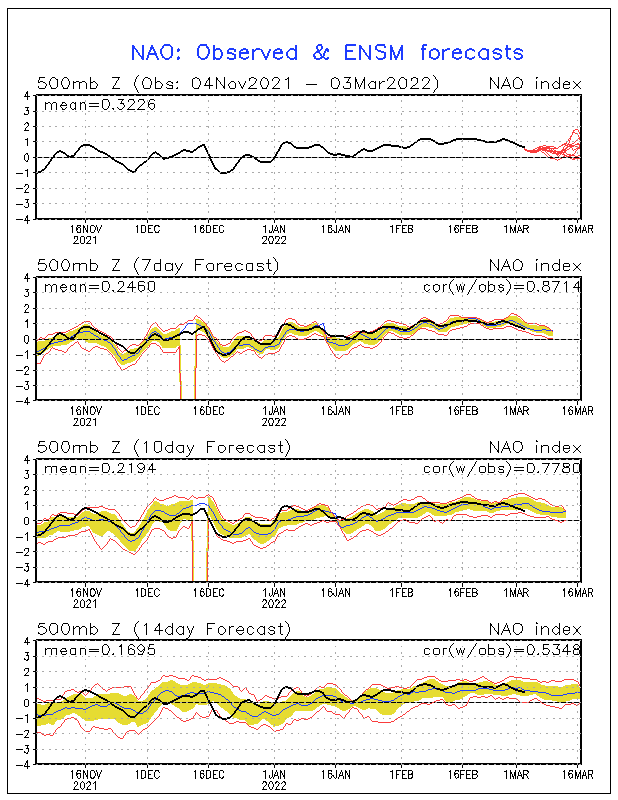
One last climate factor to mention is something called the North Atlantic Oscillation (NAO).  The NAO is measure of height and pressure anomalies from over Greenland and from farther south over the North Atlantic (35N-40N latitude).  It's depicted in what's called a 'negative' or 'positive' anomaly.  For a positive anomaly, northern France in the summer could see higher then average temperatures and the opposite for a negative anomaly.  The NAO also impacts the location of the North Atlantic jet stream, which plays a large part in steering storm systems.  Leading up to the WEG, the current NAO index and subsequent jet location will give us an idea of where large-scale weather systems could be steered!  At this moment, the NAO index is slightly negative and forecasted to climb near 0.  The Climate Prediction Center of the National Weather Service (NOAA) puts out a 14-day NAO outlook: http://www.cpc.ncep.noaa.gov/products/precip/CWlink/pna/nao.sprd2.gif.  When we get to mid-August this is definitely something we will be paying attention to!

We're excited about the World Equestrian Games and it's beautiful location in Normandy!  Check back tomorrow for a more detailed look at how weather is forecasted in France.  Please leave a comment or email equuswx@gmail.com with any questions and be sure to visit www.equuswx.com!               


Websites/References:
http://www.normandy2014.com/
http://koeppen-geiger.vu-wien.ac.at/
http://www.caen.climatemps.com/
http://www.cpc.ncep.noaa.gov/

Friday, May 2, 2014

Thunderstorms - To Turnout or Not Turnout?

Horse people know that when severe weather threatens having horses adds a whole other aspect of preparedness that needs to be considered.  Most everyone has heard what actions you personally should take when tornadoes and severe thunderstorms are expected: 

-Do you have that interior ground floor level room ready to be occupied in the event of a tornado warning?  Check. 
-Is everyone in your family accounted for and familiar with the chosen sheltering room?  Check. 
-Are your dogs/cats/birds/turtles (whatever!) easily transported to or already in your room of choice?  Check. 
-Can I get my horse into the house and if not into the interior room at least away from windows?  Probably. 
-Is this a good idea?  Probably not!

So what do you do with your horses when severe weather is expected?  This is something that I've thought a lot about through the years as it's not just my horses that my family was responsible for but our boarders horses.  Unfortunately, there's not a black and white answer to this.  Like most things when dealing with horses, a lot of preparation and a little common sense is involved!  Hopefully, the following information will help you tailor a weather preparedness plan specific to your horses' needs and give you piece of mind when the next thunderstorms roll through. 

Photo credit: Paul Suffern from the DC, Virginia and Maryland derecho event that took place the late evening of June 29, 2012.  Our horses were in the barn for this!


Preparations


One thing to definitely keep in mind while reading through the rest of this article is that if you can hear thunder then lightning can strike where you are.  Thunderstorms are not the time to be riding a horse and at the first sound of thunder or when you know a storm is approaching is the time to head back to the barn (or already be in the barn)! 

There are several things you can do prior to a severe convective (weather people like to use the word convection when talking about thunderstorms) event that make potential power losses less traumatic and make dealing with storm damage easier.  Here's the check list that I run through before severe weather:
  • Do I have enough water or a water source in case we lose power? 
Like most barns, our place is fed by well water and a pump, which does not work without electricity.  We do have a generator but like to have stored water for 48 hours just in case.  You can use pond water if you have a pond but also have several 5 gallon gas cans reserved to hold JUST water.  You can get them at Target, Southern States or pretty much anywhere.  Just make sure you write on the can that it's only to be used for water!  Also, filling up outside water troughs to the brim is a good idea.

  • Do I have enough hay and feed to make it several days?
  • Do I have enough gas for my generators if I'm planning on using them?
  • Do I have 10-20 spare fence boards and a few 4x4s in case of damage?
If storms cause damage, lots of people will be running to Home Depot so they can make repairs.  It's nice to have spare fencing so you don't have to go to the store with everyone else!
  • Are the horse trailers parked away from trees? 
We had a branch come very close to hitting one of the trailers parked at our farm one time.  Ever since then, I've tried to leave them away from under large limbs when parking.

Turnout


Turnout during severe weather is a situation where you need to consider your horses' specific living conditions.  It may be better for someone a mile down the road to leave their horses out while it's best for your horse to stay in side.  If you have a large field with a very small number of trees it could be best to leave the horses outside.  That way they are not trapped inside the barn if the structure to the barn is compromised.  It's even better if there is a run-in in the field where the horses can be sheltered from hail and flying debris on three sides.

Our farm is located in central North Carolina and most of our fields have a lot of trees that the horses like to stand under when it's raining.  For our specific situation, I feel like they are safer inside the barn away from flying debris then outside.  We've had numerous trees fall down inside the fields during storms so when we know thunderstorms are likely (and especially with severe storms) we keep them in their stalls. 

A major consideration when deciding to keep your horse up or turn them out is your horse's temperament.  Is your horse used to being stalled or outside all the time?  A horse used to 24 hour turnout will be pretty unhappy being put inside for 12 hours.  I say 12 hours because turnout decisions most of the time have to be made at morning and evening feedings.  Most jobs don't let you run home to put your horse inside whenever a thunderstorm is approaching!  Horses used to being out all the time could hurt themselves running around on slick ground with pent-up energy when put back outside.  A horse that's used to being in a stall and in regular work will be find inside.  Communicating your weather plan to other caregivers to your horse is also important.  You don't want your house sitter having to deal with a mess when you're out of town!

Weather Information


So where do you find information about severe weather that will help in your daily horse care routine?  The United States National Weather Service has 122 offices with about 20 forecasters per office across the United States http://www.weather.gov/.
 Photo Credit: http://www.srh.noaa.gov/

Each office has forecasters that work around the clock every day of the year.  They are the ones who put out the Watches and Warnings you hear on your weather radio, TV, smart phones and radio!  When you visit http://www.weather.gov/ go to the top left corner and type your zip code and you'll be taken to a page with a forecast for your specific area.  All active warnings, watches and advisories are posted underneath a red bar above the forecast graphics.  The image to the left below shows a circled flood warning and the one to the right a product called the 'Hazardous Weather Outlook' (or HWO).  The HWO is a good thing to look at as it will mention the possibility of severe thunderstorms several days in advance.


Your local news stations are a great resource for severe weather!  Make sure to watch your local news as the National Weather Service and media communicate frequently.  A lot of local news stations have weather apps for your phone so be sure to check on that as well.  

One last weather resource is something called the 'Convective Outlook' issued by the Storm Prediction Center based out of Norman, OK: http://www.spc.noaa.gov/products/outlook/.  They will highlight out to 3 days the potential for severe thunderstorms to develop.  There are 4 levels that you will see, each signified by a different color.  Green is called 'SEE TEXT' and means the area is being watched because conditions could develop that may lead to severe thunderstorms.  Yellow is a 'SLIGHT' risk and means there's an elevated chance that severe weather may occur.  Red is a 'MODERATE' risk and means the situation is pretty serious.  Severe storms are expected to develop and people need to pay very close attention to the weather.  Purple is 'HIGH' risk, which you see maybe once or twice a year.  When you see a high risk for your area, it's an extremely dangerous situation.  Definitely activate your severe weather plan!  

I hope this information has been helpful or at least will ease your mind the next time storms affect your area!  Please send an email to equuswx@gmail.com if you have any questions and visit http://www.equuswx.com/!